When a Ceramic Chip Is More Than a Cosmetic Flaw
A ceramic chip can affect handling, food contact, or stability. Learn what to inspect, when to set a piece aside, and how to choose a suitable repair.
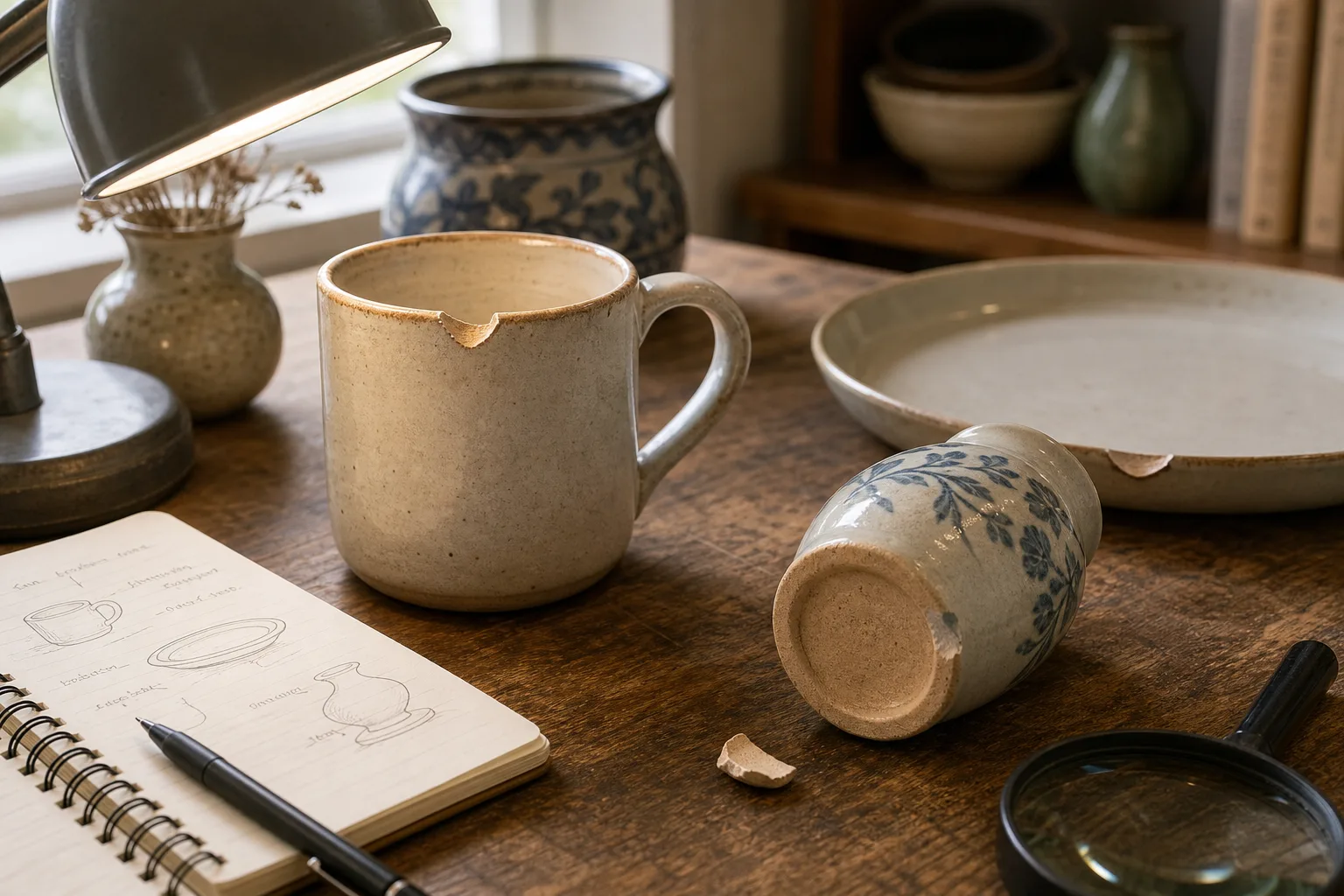
Is a ceramic chip safe to use, or should you set the piece aside? With a ceramic chip, the location and the object’s job matter more than how small the damage looks.
A nick on a vase’s foot is different from a broken spot on a mug’s rim. Inspect the damage in bright light without touching a sharp edge, then decide whether to pause use, seek qualified advice, or give the piece a non-food purpose.
Damage signs
A mark in glaze may be a surface scratch; a chip means material is missing. A crack is a visible line that may extend beyond the surface. These signs can be difficult to distinguish, so do not tap, bend, or stress the piece to test it.
Look from more than one angle. Note whether an edge appears jagged, a fragment is loose, or a line continues from the damaged spot. If you cannot tell what you are seeing, pause ordinary use until a qualified ceramics professional can assess it.
Pay close attention to chips near a handle joint, narrow rim, pedestal, or supporting foot. Damage there may affect how the object is held or supported, even if it looks small.
Is a ceramic chip safe to use?
Can I drink from a chipped mug?
Stop using a mug with a chipped rim for drinking until a qualified ceramics professional assesses it. The edge may be sharp or uncomfortable, and the damage can make the condition of the mouth-contact surface harder to judge.
Can I use a chipped plate?
Set a plate aside for food if its edge is sharp, a crack is visible, or damage is on a food-contact surface. A neat-looking repair is not, by itself, evidence that the plate is suitable for food.
What if the chip is on the underside?
A stable chip on a display piece’s foot may be less concerning if it has no loose or sharp edge, does not make the piece wobble, and has no visible crack extending from it. Check that the piece sits securely; ask a qualified professional before relying on it to support weight or hold food or drink.
Can I put a chipped piece in the dishwasher?
Do not machine-wash a cracked or repaired piece unless the product instructions and a qualified professional confirm that this use suits the specific repair and object. For an otherwise intact chipped piece, follow the maker’s care guidance; if damage makes that guidance unclear, set it aside rather than risking unsafe handling.
Location and use
Check the rim, interior, handle joints, base, and any surface that touches food or supports weight. Let the observation guide the next move:
- Rim or mouth-contact area: If the edge looks sharp or irregular, stop eating or drinking from the piece; if the damage is present but the edge looks smooth, set it aside for assessment instead of assuming it is suitable.
- Food-contact surface: If a chip, crack, or repair is where food touches, pause food use and ask a qualified ceramics professional; if damage is elsewhere, check stability and handling before choosing another use.
- Handle or joint: If a crack or chip reaches a handle connection, do not carry the object by that handle; if the connection looks intact but the object is heavy or filled, use a stable alternative until it is assessed.
- Foot or base: If the piece wobbles or has a loose fragment, stop placing it where it could tip; if it sits steadily and has no loose edge, consider display use away from frequent handling.
- Heat or washing: If the maker’s guidance does not address the damage or repair, avoid heating and machine washing; if the guidance rules out either use, follow it and choose a gentler purpose.
- Decorative surface: If the piece is stable and has no hazardous edge, display it where it is unlikely to be handled often; if it is unstable or sheds fragments, store it securely and seek repair advice.
Say you find a small nick on the foot of a vase used for dried flowers. You inspect it under a lamp without touching the edge, see no loose fragment or extending crack, and place the vase on a level shelf. If it sits steadily, display use is a reasonable choice; if it rocks or the damage spreads, remove it from display and ask a ceramic restorer to assess it. That choice does not automatically apply to a mug, whose rim and interior have different contact with a person and its contents.
Repair choices
A conservator can advise on a valuable or culturally significant piece, while a ceramic restorer may repair damage for display. Household adhesives can hold a decorative object together, but appearance alone does not establish suitability for eating, drinking, heating, or washing.
Epoxy, cyanoacrylate glue, and repair putty have different intended uses. A product label that mentions food contact may not cover every repaired joint or use. Read the instructions and ask the manufacturer or a qualified ceramics professional if the intended use is unclear. Food-contact, heating, and washing suitability depends on the particular ceramic, damage, repair product, and use.
For an heirloom, signed piece, or object with cultural significance, seek conservation advice before gluing or filling the damage. Keep any fallen fragment in a clean, labeled container; do not force it back into place.
For an ordinary decorative object, a repair may restore stability or appearance. If the object is meant to hold food or drink, be heated, or carry weight, ask whether the specific repair is suitable for that purpose. If a qualified professional cannot confirm food or drink suitability, choose display or another non-food role instead.
Inspection decisions
- Set it down safely. If a fragment is loose, an edge appears sharp, or the object wobbles, stop using it and place it somewhere secure; if none of those signs is present, continue with a visual inspection.
- Inspect in bright light. If you see a crack, missing material, or loose piece, pause ordinary use; if you see only a surface mark, check its location before deciding.
- Check contact and support areas. If damage reaches a rim, food-contact surface, handle joint, or supporting base, set the object aside for that use; if it is away from those areas, assess stability and handling.
- Match use to condition. If damage affects a food, drink, heat, or load-bearing function, stop that use; if the piece is stable and intended only for display, display it away from frequent handling.
- Choose a repair route. If the piece is valuable or significant, contact a conservator or ceramic restorer before altering it; if it is an ordinary decorative item, follow the repair product’s instructions and use it only for purposes the product and a qualified professional support.
- Reassign its purpose. If food use is uncertain, reserve the piece for display only when it is stable and has no hazardous edge; if it remains unstable or sheds fragments, store it securely instead.
A ceramic chip matters when it changes how reliably the object can be handled or used. Look at the edge, surrounding surface, and contact points before choosing repair or another purpose.
For a ceramic chip, base the decision on the object’s actual job. If no qualified professional can confirm that a repair suits food, drink, heat, or washing, keep the piece as a stable display object or keepsake rather than treating a polished surface as proof of suitability.
Nearby questions
Why Paper Buckles When Glue Dries
Why paper buckles when glue dries—and how grain, adhesive, and gentle pressing can help a bonded…
The Cut List That Saves the Last Good Board
A woodworking cut list helps fit parts to usable stock, account for kerf and defects, and…