The Recycling Symbol Does Not Tell the Whole Story
The recycling symbol can hint at a material, not promise collection. Learn how design and local recycling rules shape what happens to an item next.
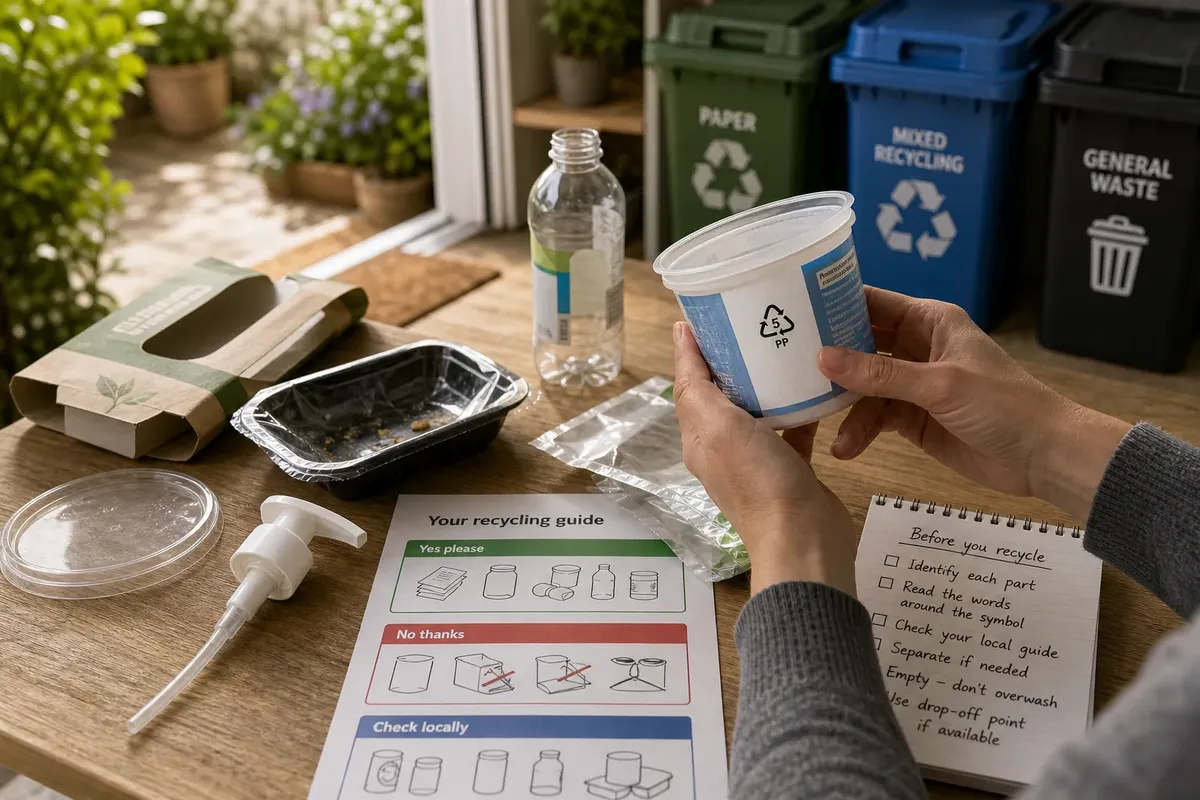
The recycling symbol on a yoghurt pot does not promise that your local service will take it. A recycling symbol identifies or suggests something about the material; whether an item is collected, sorted and turned into usable material depends on its design and local arrangements.
That gap matters because a familiar mark can look like a clear instruction. Treat it instead as a clue, then check what your council or waste provider accepts and how the item is made.
What does the recycling symbol actually mean?
The three chasing arrows are commonly read as “this will be recycled”. On many plastic packages, however, a number inside the symbol identifies a resin type. It describes the plastic, not the route the package will take after you put it out for collection.
Other marks can refer to recycled content, packaging components or a producer’s own instructions. A label may be helpful, but it is not automatically a universal permission to place an item in the recycling bin. Look for explicit wording such as “widely recycled” or “check local recycling”, and treat that wording as a prompt to verify rather than a promise about every collection scheme.
Why can the same package be accepted in one place but rejected in another?
Recycling depends on the system that serves your home. Councils and contractors may collect different materials, use different sorting equipment and send recovered material to different processors. A package accepted at a nearby supermarket collection point may not belong in your kerbside bin.
Even where a material is technically recyclable, a local service needs a route for collecting and handling it. If a sorting facility cannot separate an item reliably, or a processor does not want that grade of material, the item may be removed from the recycling stream.
Check your council’s online recycling search or printed collection guide for the exact item. Search for the package itself, not just its material: “plastic tub” may receive different advice from “plastic film”, even when both are plastic.
How do material and design change what happens next?
Packaging is often a combination of materials chosen to protect, seal or display a product. A paper sleeve around a plastic tray, a foil layer bonded to card, or a bottle with a different-material pump can be harder to sort than a single-material item. The recycling symbol on one part does not necessarily describe the whole package.
Shape and size can matter too. Small pieces may fall through sorting equipment, while flexible films can behave differently from rigid containers. Dark colours, labels, adhesives and residue can also affect identification or processing, depending on the equipment and the material being recovered.
Imagine you have a ready-meal tray with a cardboard sleeve and a plastic base. Your local guide accepts clean cardboard and certain rigid plastic tubs but says nothing about trays. The useful decision is not to infer that the whole package is accepted from one symbol: separate the sleeve if the guide allows it, then check the tray’s specific instructions.
What should you do with a confusing label?
Use a simple order of checks rather than relying on the logo alone:
- Identify each part. Separate the lid, label, tray, sleeve or pump in your mind; a package can contain several materials.
- Read the words around the symbol. Look for a material name and any instruction to check locally.
- Consult your collection guide. Search for the item type and follow the rules for your own address.
- Check whether parts should be separated. Some services ask for components to be detached; others prefer them left together.
- Follow instructions about emptying or cleaning. Avoid adding extra washing unless the guidance asks for it.
- Use a named drop-off point only if it is available to you. A specialist collection route is different from kerbside recycling.
Where the answer depends on a label, manufacturer instructions or local rules, follow that source rather than guessing from the symbol. If the council guide is unclear, its waste service can clarify what it accepts.
What happens after an item goes into the recycling bin?
Collected material is taken for sorting, where equipment and workers separate materials into streams. Items that do not fit the service, or cannot be sorted as intended, can be rejected. The remaining material may be processed into a form that a manufacturer can use, but the result depends on its quality and on demand for that material.
Recycling is therefore a chain, not a property printed on an object. A mark may indicate that a plastic type has a recycling route somewhere, while collection and processing determine whether that particular item reaches it. Contamination from food or from incompatible materials can make the job harder, so follow local advice on preparing items.
Which recycling-symbol questions come up most often?
Does the number inside a plastic triangle tell me where to put it?
Usually, the number identifies a type of plastic rather than giving disposal instructions. Check your local service’s accepted-item list, because collection decisions are made for specific objects and materials.
Can I recycle an item if it has no symbol?
Possibly: the absence of a symbol does not by itself make an item unrecyclable. Search your local guide by its material and form, such as a glass jar, paper envelope or rigid plastic container.
Should I remove labels and wash containers?
Follow your local instructions: services differ on whether labels should stay on and how clean an item needs to be. Do not spend time scrubbing packaging beyond the preparation your service requests.
Is a compostable package suitable for the recycling bin?
Not necessarily. Compostable packaging may need a separate collection route, and it can interfere with conventional recycling if mixed in. Check the package directions and your local waste guide before disposing of it.
What is not worth the effort?
It is rarely useful to decode every small resin number or meticulously peel every label without a local instruction telling you to do so. That effort can create more confusion than benefit, especially when the service sorts those components itself. A quick check of the accepted-items guide is usually the more practical move.
The recycling symbol is useful when read as a material clue, not a certificate of what will happen next. For the recycling symbol on an item you are holding, check the package’s separate parts and your local collection rules; that small pause helps keep the recycling stream closer to what its processors can actually handle.
Keep exploring

What a Refillable Container Changes After the First Use
Refillable container choices depend on design and routine. Learn what to check so the container suits…

Borrow, Rent, or Own the Occasional-Use Tool?
Borrow, rent, or own an occasional-use tool with a clear way to weigh access, storage, availability…